Does design ground us, or does it transport us? Ultimately, I like it best when it does both.
Airline and aircraft design – a design discipline that has always held my steadfast fascination – is as good an illustration of this idea as any.
But I am admittedly biased. I developed an early fascination with airplanes and air travel. In my adult life, that fascination continues to manifest in my passion for and dedication to travel, adventure, and exploration.
While I appreciate the perfect precision required of aircraft engineering, let me just say up front that it is the decorative, experiential layer – from the advertising materials to the terminals and the lounges to the on-board cabins and uniforms and amenities – that holds my attention and continues to fuel my obsession with aviation.
Growing up in the 70’s, my childhood coincided with the launch of the Boeing 747 (first christened in 1970), and it seemed that there was always someone within or close to the family coming from or going to some exotic, faraway place on a somewhat regular basis.
While I have been fortunate enough to travel far and wide and on a variety of aircraft types, I missed that golden age of travel. That era when traveling by airplane was not just about traveling in style, but was more significantly a thoroughly designed experience.
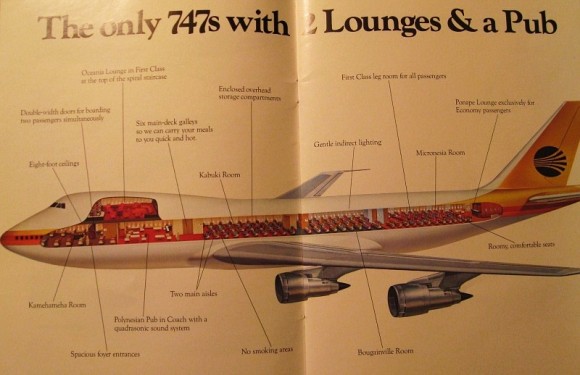
Look carefully at the above image of a Continental 747 in the early 70’s. First class legroom for all passengers? A Kabuki room? A Polynesian Pub? And a lounge at the back for Economy passengers, nevermind the bubble lounge – or “Oceania Lounge at the top of the spiral staircase” – for First Class passengers.
No wonder family and friends would arrive for a visit dressed in their finest clothes. They would walk through the door carrying their best luggage. They would regale me and my sister with tales of “the flight,” discussions of who they met at the airport or on the plane, what they ate and drank “aloft.” They’d shower us with “flight tokens” – pin-on wings, chocolates, menus, empty liquor miniatures. And no sooner had one person told us about the trip they just took, another was talking about their next trip – discussions with travel agents, shopping for clothes, organizing hotel rooms and dinners in places as near as New York and as far as Saigon.
Born with an innate sense of wanderlust just waiting for an outlet, I developed an outright obsession with the 747. I was particularly fascinated by that “bubble lounge,” the enclave of elegance at the top of the stairs that I had heard so much about.
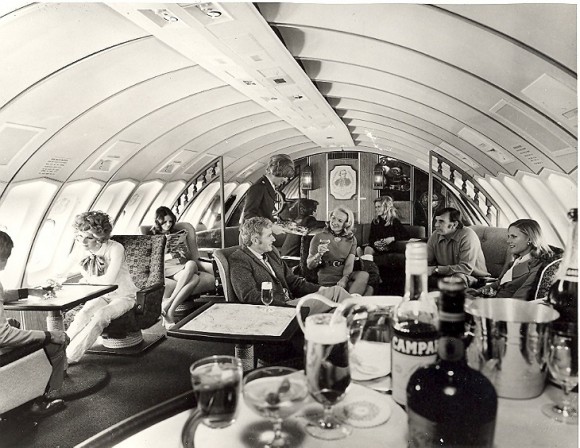
Note how smartly dressed the passengers are, sitting in their swivel chairs, sipping their cocktails from real glasses, playing their card games. The experience was an aesthetically driven one down to every last detail.
No surprise, then, that I developed this fascination with model airplanes (buying them or receiving them as gifts more than making them, mind you). Not fighter planes or floatplanes or biplanes, but airplanes that went somewhere. Especially that 747. That was, is, and probably always will be my favorite. It took people places. It made the world accessible, possible, approachable, and desirable.
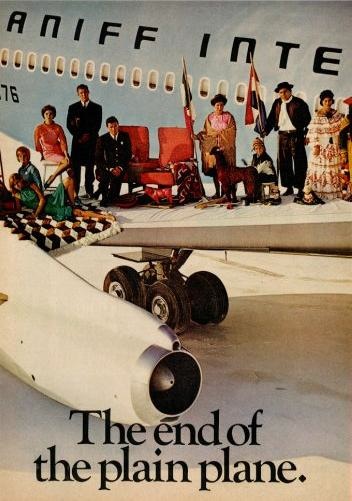
The 747 was sleek and serious and sophisticated, but it was also fun and playful and frivolous. From the very beginning, it was an example of something that could transport you there while grounding you here, as was evident in the adventurous ad campaigns, this one from Braniff International, that featured people and animals from all over the world on the wing of a pleasantly-colored airplane.
This was the time when the MetLife Building at Grand Central Station in New York was the Pan Am Building. When the airline industry was among the most profitable industries in the world. It was thus that the airline industry during this time achieved nothing short of aesthetic excellence. Architecture, interior design, fashion design, graphic design and the culinary arts combined to make a traveling aesthete’s dream come true.
An outstanding architectural example of this was the Pan Am Terminal at JFK Airport in New York.
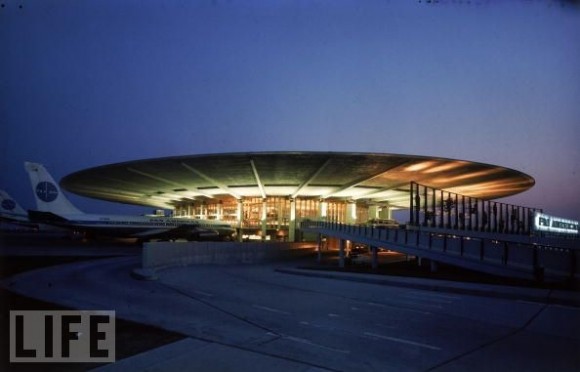
Ingeniously dubbed the Worldport in 1971 when it was expanded to accommodate the 747 aircraft, this building was nothing short of an architectural marvel and design statement. The 16,000 square metre (or 4-acre) flying saucer was designed by Turano & Gardner Associated Architects in collaboration with famous airport designer Walter Prokosch, and embellished with zodiac figures (how apropos) created by the famous sculptor Milton Hebald.
The overhang functions to protect people as they embark and disembark the aircraft but at the same time its flying saucer design, complete with zodiac embellishments, participates in and informs a narrative about the jet-set life. Emphasizing the safety of a home base coupled with the promise of once-impossible explorations and experiences, this terminal was a perfect combination of sophistication and suitability, of function and fantasy.
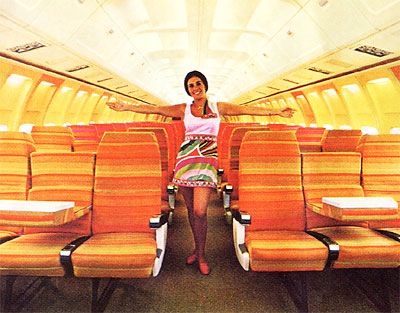
But the terminal was just the design parenthetical within which the actual trips took place. The interiors of airplanes were outfitted in those days by people like Alexander Girard with Herman Miller fabrics for Braniff, such as the one below.
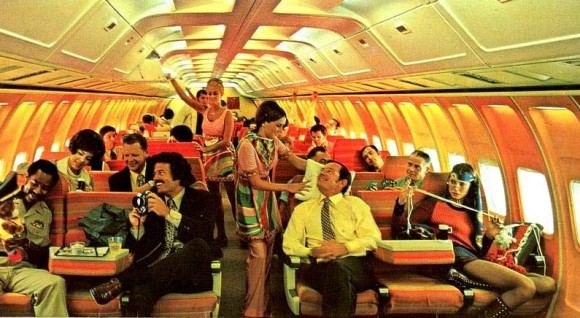
Girard designed over 17,000 products for Braniff International, and was largely responsible for what remains today one of the most succesful branding ventures in history. There is actually an informative post entitled “Branding Braniff International”,written by a pilot named Marty, featured on a blog called flight.org (of which I am a big fan), for anyone who is interested in delving deeper into that subject.
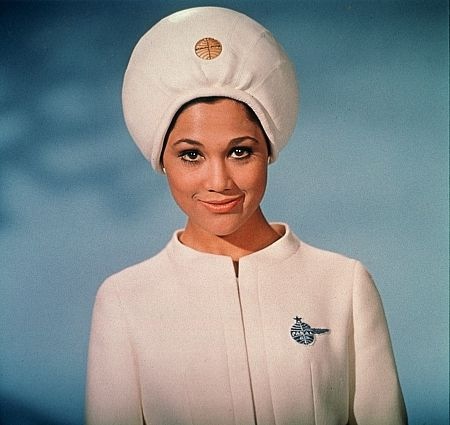
The design didn’t stop with architecture or the airline interiors. It extended to fashion as well, with uniforms designed by Emilio Pucci and Beth Levine for Braniff, and by Hollywood costume designer Edith Head for PanAm. Flight attendants (more akin to today’s runway models) would change uniforms once, twice, three times during long-haul flights. (it’s definitely worth checking out the video called the Braniff Air Strip, where an air hostess takes it all off!).
Just imagine boarding your flight for LA or London and spotting this:
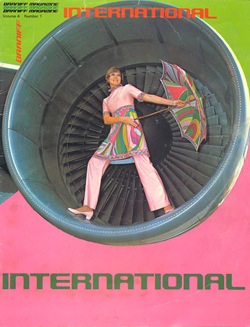
…and stepping on to the plane to be greeted by her:
or her…
As further testimony that good design goes hand in hand with good living, the culinary experience aloft was as thoroughly designed and integrated into the experience as the terminals, interiors, and uniforms were. Custom airline china was created by top companies like Bauscher Weiden and Noritake, some of which are quite valuable today.
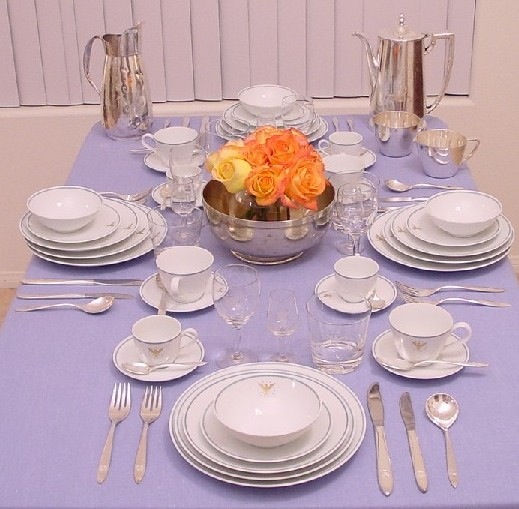
Architecture, interiors, unifroms, place settings. And oh yes, paper products. The in-flight menus (featuring food by Maxim’s of Paris on many Pan Am flights) became limited edition prints created by artists of the day such as Dong Kingman or Ivan Chermayeff, some of which are now highly collectible and valuable. These menus featured on Pan Am’s Round the World Service in the 1970’s.
I am a stationary fanatic, and I have a real soft spot for a beautiful paper product of any and every kind. I’ve seen some of these menus in person, and they are breathtaking. These were bespoke stationary creations, devised for particular flights, seasons, and even groups. The graphics corresponded to the origins and destinations of the flights.
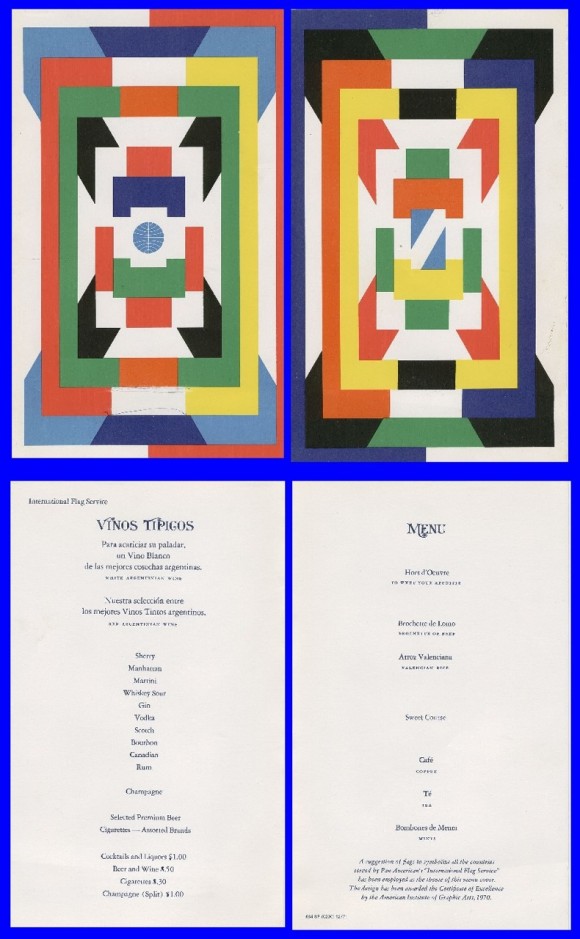
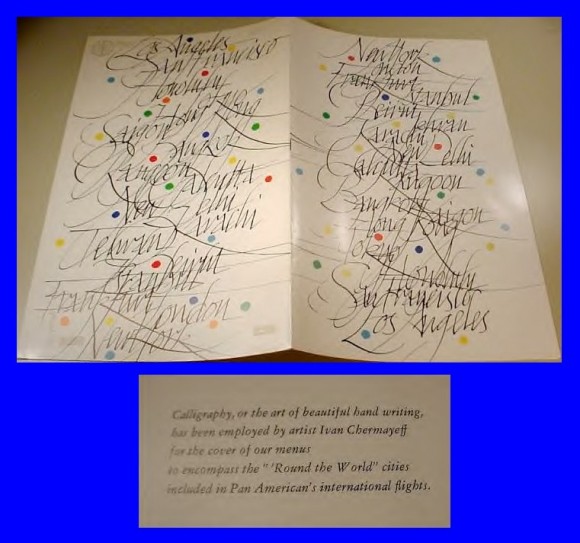
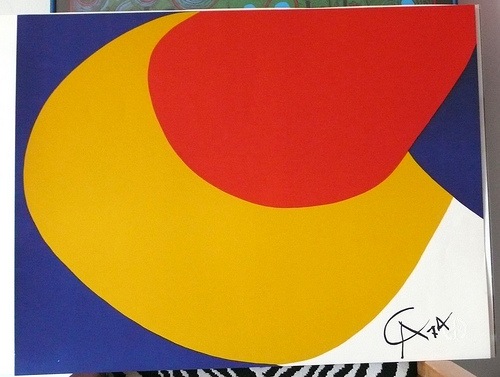
The relationship between visual art and design did not stop with the menus, though. Alexander Calder, for instance, painted several planes for Braniff, stating that such planes “would be flying mobiles.” Who better than Calder ,then? Note how the painting becomes the plane.
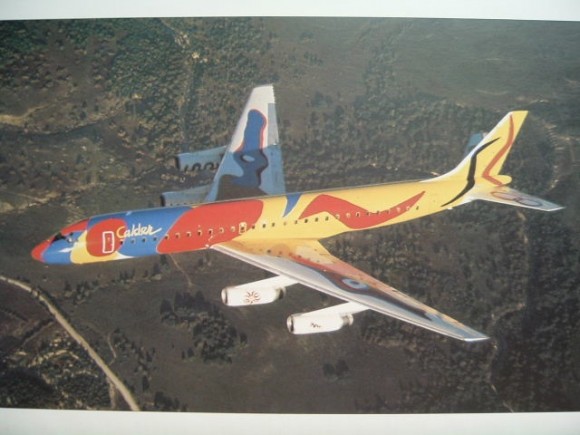
Air travel was a thoroughly designed experience, where architectural, interior, product, graphic, and fashion design met culinary connoisseurship and the art world in the interest of creating an experience. That is what I like to think good design is all about: creating circumstances that encourage the enjoyment of an experience.
Is the travel-by-air experience as designed as ever today? Or have we come to take it for granted, relegating it to a means to an end instead of an experience in its own right? We go places. We bring things home. Our designs are influenced by trips to and objects brought back home from other places. It often occurs to me that this seems to be the entire goal of travel these days: get there, get stuff, get home. If this is true, and if getting there is half the fun, and is meant to be its own experience apart from the experiences on either side of the trip, then we’ve lost something important. We’ve lost the joy of the journey. Design can, in my experience and opinion, change that.
The idea that one can go so easily from Houston to Paris, from New York to Rio, from Washington to Nairobi, or from San Francisco to Tokyo – all in a matter of hours – continues to fascinate me. Even now, when I get on a 747 or other widebody aircraft, and see that map on the screen that announces I will be somewhere on the other side of the world in eight or ten or twelve hours, I am overcome with a childlike enthusiasm tempered with an adult’s gratitude.
These are the trips that used to take weeks, if not months. We make them now in a matter of hours. We can work a full day, get on an airplane, and end up on the other side of the world in time for breakfast the next day.
Of course, this is a double-edged sword. There is no doubt that cultural compromise comes with globalization, and the jumbo jet is often cited as the icon of this. But it’s my opinion that if the designed environment of yesteryear’s aviation experiences were still upheld today, then it would go some distance towards preserving and promoting not only various destinations and cultures, but good design. Integrated design. Layered and considered and synergistic design. As a result, I think we’d probably enjoy the process of getting there and back a little bit more.
Yes, I concede that airline design is still a hot topic and an alive design discipline. These days, airlines compete with each other to be the latest, hippest, most tricked-out pads in the sky. Emirates has showers with brass fixtures. Singapore Airlines has private suites. British Airways has electric window shades. Airport lounges offer spa services and sleeping suites. But what happened to the designed experience? Where the terminals, the lounges, the uniforms and blankets and china and menus all tethered back to a design thesis, and when that design was available to everyone on the airplane, regardless of their fare basis? Planes are arguably more comfortable today. The food probably tastes the same as it always did. Some airlines’ flight attendants’ uniforms are glorious while others are positively lackluster. So there are elements of good design intention and execution in today’s airline industry, but there is no design integration. No design coherence.
And so the experience suffers, just as it would if I were designing a residence for someone and considered the living room and the bedroom in isolation from each other. They might each be fine, but there would be no relationship between them, no synergy to unify them, no plot to link them as two chapters of the same book. As I say in the Ethos section of my website, I feel that process, synergy, and relationships are of paramount importance in the design process, regardless of whether the design is of a home, an airplane, a uniform, or a piece of stationary.
The 747 is a beautiful flying machine. I remain obsessed with it, and with aviation and travel, in general. It’s as much about the journey as it is the destination.
But it’s also important to remember a sense of humor. On that note, and in closing, I have to confess that I think one of the reasons that I love the 747 so much is because, well, something about it has always reminded me of Snoopy. Just look.
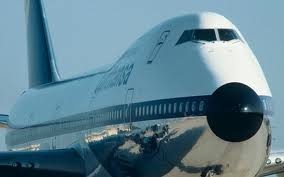
Something about the nose above reminds of the nose below…….
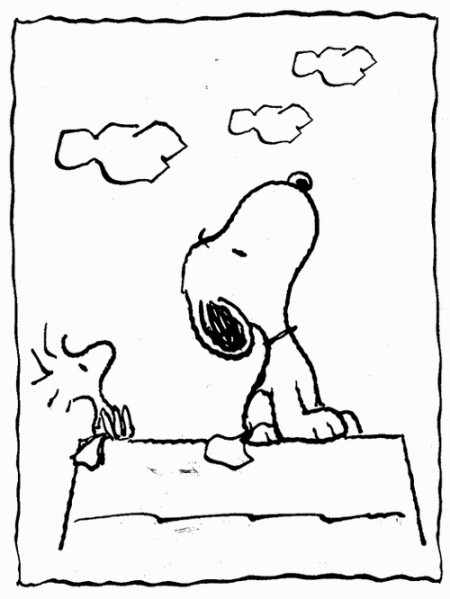
This is not an original idea. Snoopy was often seen in aviation attire (his Red Baron persona), and he went to the moon in Peanuts before Neil Armstrong did in Apollo 11 (there is actually an interesting relationship between Snoopy and space exploration, which can be viewed in more depth here if you are interested). And Japan Air Lines came up with this paint scheme which features Snoopy:
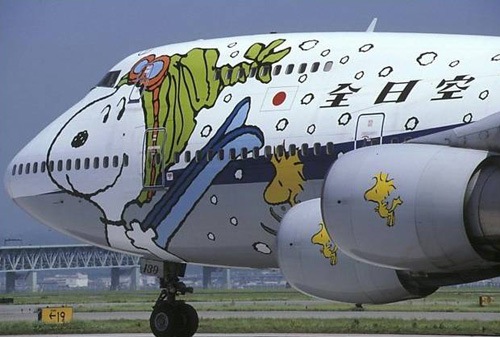
I am convinced that whoever designed the 747 was inspired by Snoopy and his aeronautic aspirations. It’s as good an inspiration as any, right?
And I say it just goes to show that a sense of humor is a critical ingredient to the enjoyment of any journey, literal or figurative, designed or otherwise. You think Girard and Pucci and Calder and Chermayeff didn’t have fun designing these things??