As I prepare to attend the 2011 Design Leadership Summit in Copenhagen later this month, I am reflecting on the 2010 Summit in Venice last April.
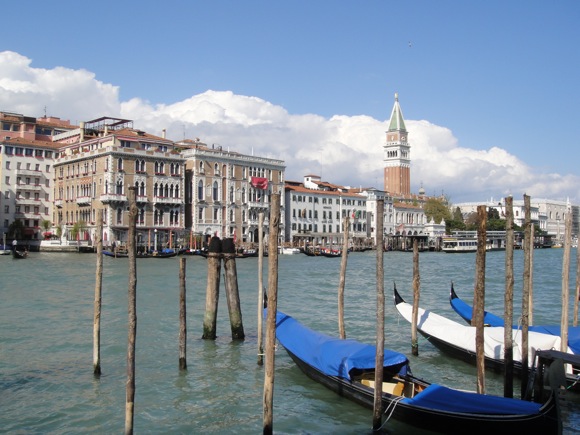
For me, one of the main highlights of the Summit was the involvement of Fortuny, not only as sponsors, but also as hosts of the closing night events. Before I expand upon these events and their venues, I want to back-up a little bit and sketch the basics of my own history with Fortuny.
While I have not always been professionally engaged as an interior designer, it has always been in my blood. As a young kid in Houston, I would play endlessly with the repository of fabric samples that were strewn about my grandmother’s study. She was working as a decorator while endlessly redecorating her own house, and I remember being fascinated by this process.
More than that, though, I was especially taken by one fabric in particular, of which she was very proud and protective. It was called “Fortuny.” I remember immediately associating it with “fortune.” And that was before I even knew what it was.
Years later, I was 24 years old and living in London. While I was reading towards a PhD in English at the Univeristy of London, I was also restoring a London townhouse, and had started my first design projects almost by accident. One of my first clients insisted on re-using some Fortuny curtains that he had brought with him from Atlanta to London. I was reluctant, but they were nice curtains and I was eager to please. Just one problem: we needed an extra panel of fabric to complete the new window.
So with the existing curtain panel in hand, and having researched Fortuny in London (this was pre-internet, mind you), I set off to find the Claremont Furnishing Fabrics Company in Elystan Street, Chelsea. Among all of Claremont’s beautiful things, I found what I was looking for: an entire wall of Fortuny fabrics in all of their murky and mysterious glory.
Upon my inquiry for a few yards of the fabric, Adam Sykes, the owner of Claremont, asked me if I was a designer. Nervous at the possibility of my naivete being mistaken for ignorance, I said without flinching, “You think I came over here with a curtain panel in tow just because it’s fun for me?” Adam opened my first “trade account” that day, and we ordered the additional fabric that we needed (nevermind that it didn’t match and we ended up entirely remaking the curtains). Two loyalties were born that day, and to this day I remain fiercely loyal to both Claremont and Fortuny.
I decided pretty much immediately and intuitively that any and everything I worked on had to have some Fortuny ingredient. This fabric had soul. It had spirit. It would lend dynamism to the most boring of rooms, no matter how it was deployed. Over the years, it has slowly become a quiet signature of my work: Fortuny (sometimes subtle and small, other times grand and gargantuan) features somehow in every project.
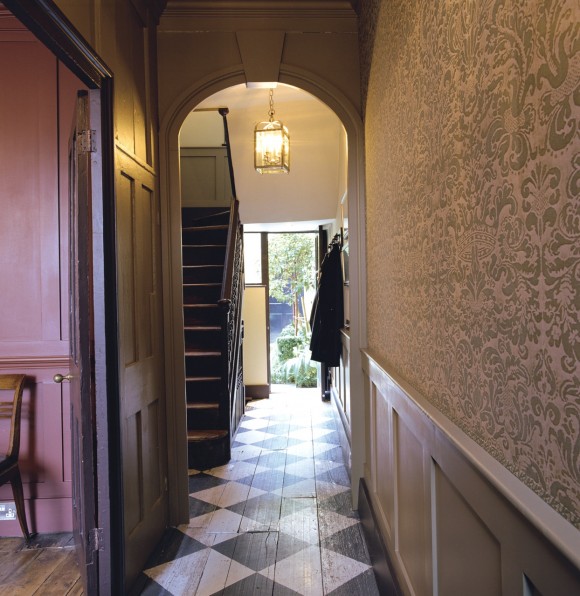
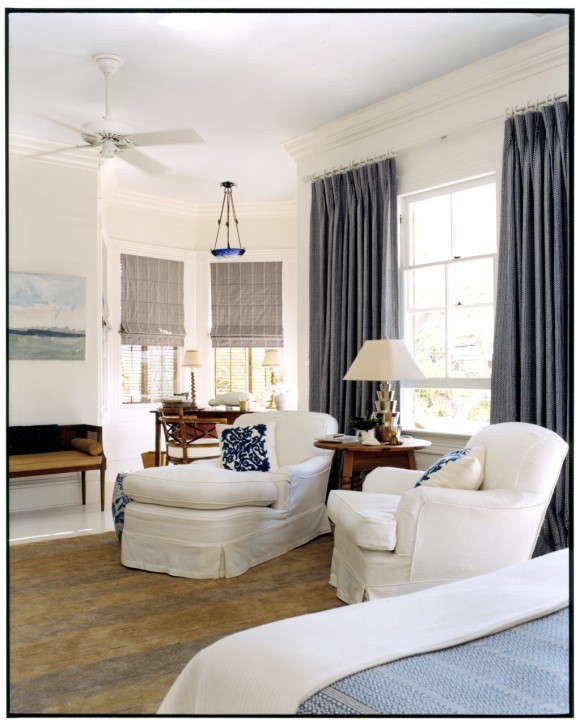
And so as my dabbles in decorating transformed into the foundation of my design business and my corresponding abandonment of academics, I used Fortuny over and over and over again. In that Spitalfields house, I upholstered my foyer walls with Corone (above). In other projects, I upholstered sofas or used Fortuny to match bedding and curtains (below). In smaller, less liquid projects, I made a pillow or fashioned a welt out of some Fortuny remnant. But it was – and is – always there.
So imagine my delight when Fortuny hosted the closing night events of last year’s Design Leadership Summit with a cocktail party in the factory showroom and gardens on the Giudecca, followed by a dinner (and some dancing, yes) in the Museo Fortuny. It was as if I had stumbled upon Design Mecca.
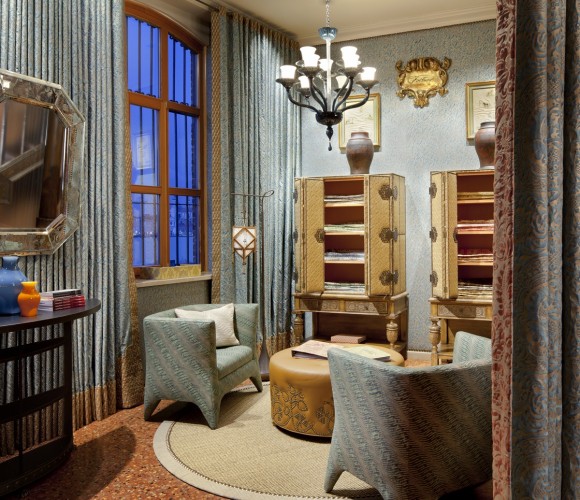
Fortuny’s Venice showroom really is an inovacation of just how versatile and transcendant the Fortuny fabrics are. Recently redone by friend and colleague Barry Dixon, the home-base showroom features a thoroughly modern design overlaid with Fortuny fabrics in every iteration imaginable. Grommeted curtains on modern metal poles, the panels faced with one pattern, lined in another, edged in a third, and detail-trimmed in a fourth. The latest collection of Fortuny pillows designed by Barry Dixon, Monique Gibson, and Thad Hayes graced the modern metal etageres. Fortuny’s exclusive in-house light fixtures hung from the ceiling and sconced the walls, while vintage panels adorned the walls.
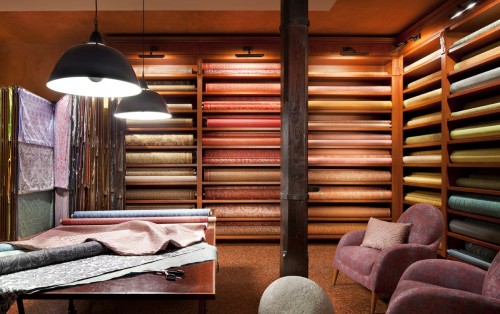
And then, of course, every fabric in every color shelved against the wall in full bolts, ready to be pulled out and inspected (and cut and purchased on the spot!) on the central cutting table.
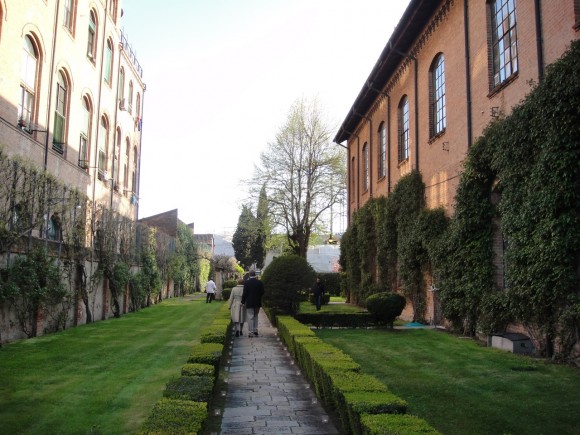
After ogling the fabrics, drinking the prosecco and eating the canapés, we were ushered to the fountained and flowered courtyard that sits beneath the looming Fortuny Factory (which has been and still is kept under tight lock and key).
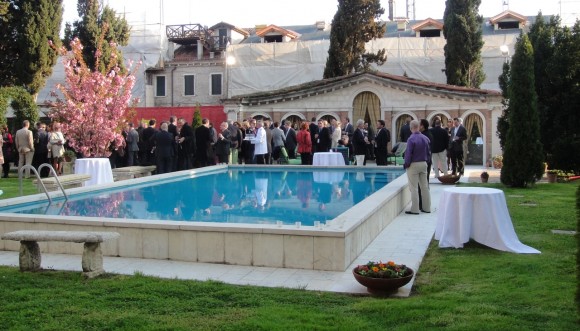
The Brothers Riad (that’d be Mickey and Maury) had gone all out – panels of Fortuny were clipped to a clothesline to hide the unsightly fence and construction beyond (one such panel was the Glicine Red Museum Texture that I had sourced so long ago in London!). There was a quartet that serenaded us, cocktails and mocktails that kept coming, delicious passed hors d’ouevre, and design-driven conversations that were inspired by being in the presence of such an awesome and timeless fabric house in such a sublime and sophisticated setting.
As the sun set over the Giudecca, we found ourselves in vaproettos at twilight, hurtling back to Venice for dinner at the Museo Fortuny.
We ascended the first flight of stairs to discover a gallery displaying many of Orlando Fortuny’s original couture dress designs, complete with the famous organza, the belted trims that must have certainly inspired the furnishing fabrics, deep banquetes of velvet with endless pillows of Fortuny fabric.
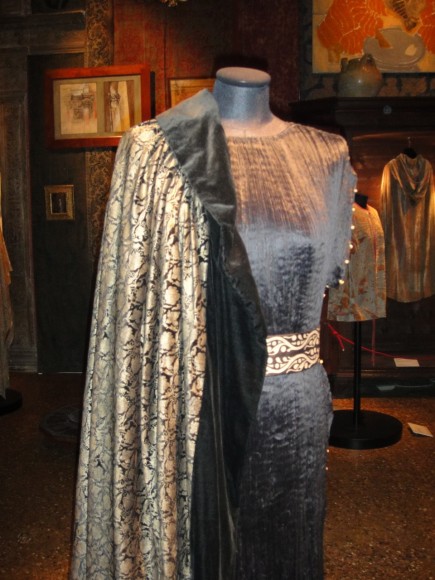
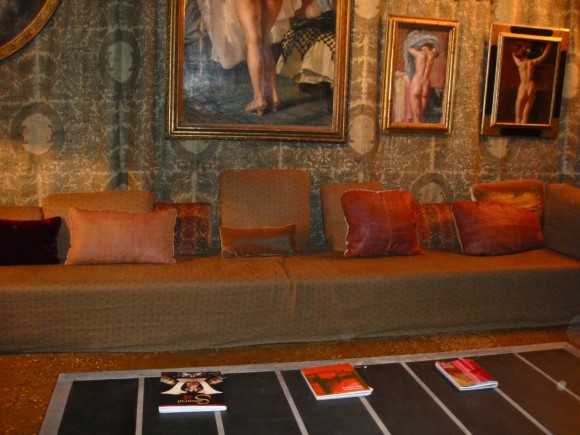
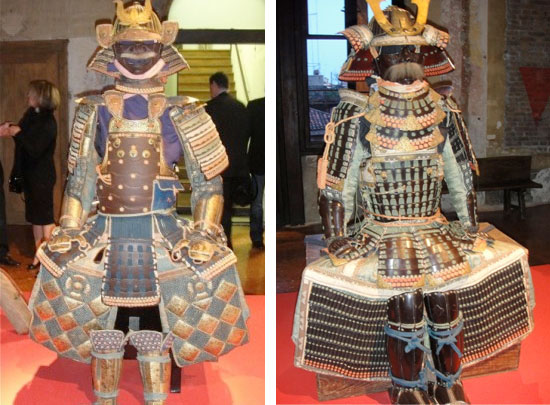
Then another flight of stairs to another gallery, this one revealing a most unexpected surprise: Fortuny’s private collection of Early Modern Japanese Samurai costumes.
Immaculately detailed in the most amazing fabrics and patterns, embroidered in gold and silver threads, sitting atop beautifully crafted wood and stone pedestals, and as currently inspiring as they were historically authentic, they silenced the room, and our clicking cameras replaced our otherwise constant chatter for a brief interlude.
For me, this entire Fortuny experience was a design destination and discovery – a veritable pilgrimage – that remains without comparison in my personal and professional life. It was the sum total of everything that I had been working with in my design business, and it referenced all of the things that I maintain as fundamental to my own personal and professional aesthetic worlds.
The layering, the timing, the element of surprise, the maintenance of mystery, the unfolding of visual and visceral events and textures – all of these things are essential to a good spatial experience. They are all part and parcel of a well-considered interior, garment, venue, event, point of view.
The story is one of a truly bespoke process and product. In his garments and furnishing fabrics, and in the way he worked to bring his ideas and notions into reality, Mariano Fortuny was a visionary. He created a bespoke product by marrying the then-disparate areas of fashion and interiors with innovative textile production techniques.
That the product is alive and thirving today, and offers endless opportunities for designers of all disciplines to create their own bespoke expressions, is testimony to the fact that he understood how to honor history, hone innovation, and foresee design evolution. Not many fabrics out there are as at home on a Knoll sofa as they are on an eighteenth-century fauteuil. To navigate the vastly varying circuses of fashion and interiors across time periods and cultures, and to do with an unwavering insistence on creative and functional integrity, is surely an essential cornerstone of bespoke design.
It goes without saying (but I’m saying it, anyway!) that it is a great privilege and a high honor that Fortuny has asked me to collaborate with them on their next collection of bespoke decorative pillows. Watch for the launch later this year!
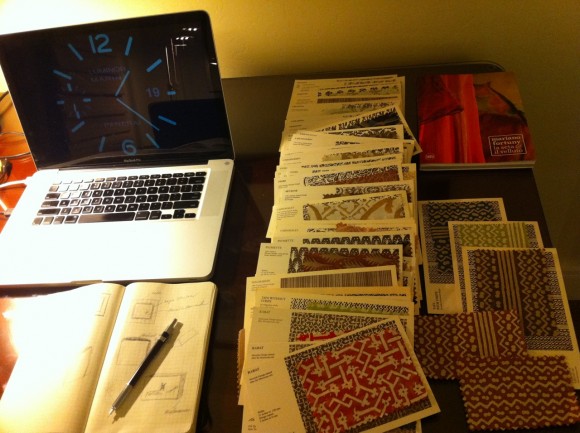
Drafting my pillow designs for Fortuny at a hotel room desk at 1:30 am. For the love of design...