
As I discuss in the Ethos section of my website, design requires an educated appreciation for the concepts of process and synergy, and a dedication to Mother Nature as the ultimate designer.
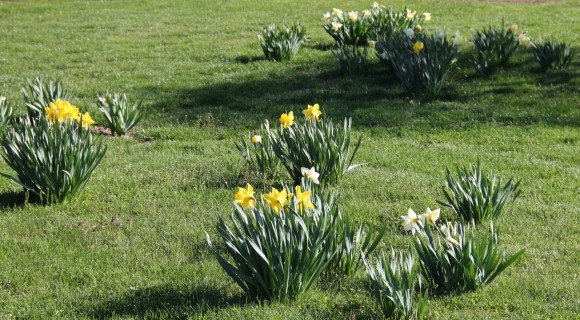
Nature and design: always works in progress.
One of the things that I want to explore with this blog is the process and synergy that are involved in creating suitable designs for clients.
Good design does not happen overnight. Achieving a nicely-polished and perfectly-styled room that is client-suitable and camera-ready takes months, if not years.
And sometimes, good projects never see the light of a professional camera lens. That does not mean that they don’t deserve credit. As I am sure my design colleagues and friends will affirm, some of the most beautiful design moments happen in isolation from public exposure and in the privacy of our own design minds and experiences.
This house that I am working on in Amagansett, East Hampton will probably never see a professional camera or the pages of a shelter magazine. And yet it is a house of amazing (albeit quirky) architectural integrity. More importantly, the decorative layering that I am creating for this house does a good job of illustrating my concept of “telling peoples’ stories through their spaces.”
These clients have a most extraordinary set of experiences to recount. From Argentina to India via Italy, and then on to Manhattan and Provence, and then back to India again but this time via Egypt; from the worlds of Wall Street’s high finance and Santa Fe’s rare pottery collections to the development of new global energy industries and a dedication to local sustainability; with an appreciation for antique Navajo textiles and German cooking molds, and a preoccupation with with Americana absurd…theirs is a story that needs to, wants to, and must be told. I feel so lucky to be one of the storytellers.
What I love most about this project right now is that it illustrates the process and the synergy that are so inseparable from the design work that I do. There are no “full room” shots here. This is, after all, a Work in Progress. As such, these images are merely about some of the spontaneous moments in the interior design process, and the normally hidden-from-view moments where that process underscores the synergy that my designs – and spatial story-telling – require.
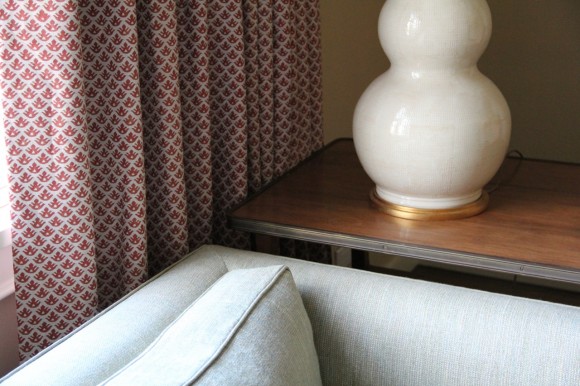
Featured above is one of those moments that capture the essence of the story. This is the library, right after the curtains were hung and the furniture was placed. This is always a very happy, but often unsung, moment during an installation. The curtains are Fortuny‘s Canastrelli. The sofa is vintage Billy Baldwin, newly upholstered in a grandchildren-friendly fabric from Rogers and Goffigon. The table is vintage Rose Tarlow, and the lamps are by Christopher Spitzmiller. Soon we will add antique textile pillows, followed by a custom carpet featuring an ancient geometric Persian design but rendered in monochromatic shades of neutral sisal and wool.
Below is the Master Bedroom, which was conceived as a sort of ode to the subtle shades of blue and green that the clients so love (blue and green happens to be one of my personal favorite combinations as well). As I was running around putting things into position, I saw the light coming through the curtains in the most beautiful way, and I had to stop and snap this picture:
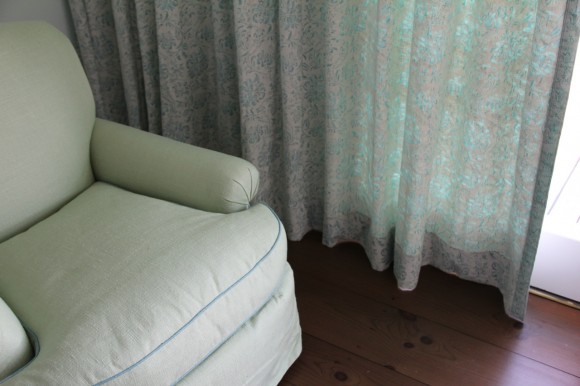
We made the curtains out of Fortuny’s Cimarosa fabric, the borders of which we removed and re-applied as leading edges. As the clients did not want a blacked-out room, we just specified these curtains to be properly lined and interlined, but without the layer of black sateen interlining. This is what allows the light to shine through in the most sublime way while still protecting the the items inside the room from fading.
I should also mention that I used these curtains to solve a problematically-placed window on a strangely-angled wall. It’s important to remember that good curtains have a function – several functions, actually – and are not just something to make a room look pretty. And while we are telling the client’s story, we also have to honor the house’s own peculiar contributions and its own story.
The club chair (one of a pair) is upholstered and welted in two colors of Pierre Frey‘s Collobrieres, one of my all-time favorite woven upholstery fabrics. These two fabrics will also comprise the bedroom’s upholstered headboard, which is still in production. It’s very rare that everything arrives all together, anyway. There’s that emphasis on process again!
While we are at it, let’s back up and look at the entire room scheme as it first appeared in my Studio at the beginning of this process several months ago. In the picture below, note the curtain and the upholstery fabrics from the picture above. The bedskirt will be made of the curtain fabric, but the kick pleats will be lined with the Fortuny petit-motif called Canastrelli. Yes, that’s the same pattern we used (intentionally) for the library curtains showcased in the very first photo, but in a different colourway. Sometimes, I find that this type of carefully considered repetition helps to establish the foundation – or storyline – of an interior’s design. Particularly in this odd-shaped room, I needed to restrict the soft elements as much as possible to introduce the sense of repose that I feel is crucial to this kind of bedroom.
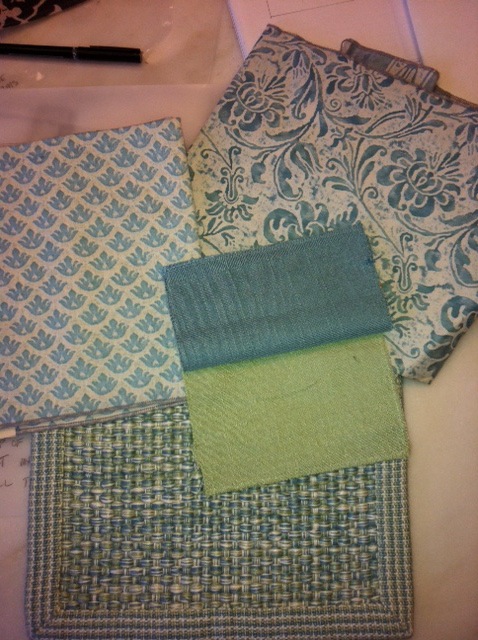
Looking at this picture now, I remember how excited I am to to see the carpet for this bedroom. We worked with Analisse Taft from ALT for Living to create this custom carpet, which is made from 100% linen in colors taken from the Fortuny and Pierre Frey fabrics elsewhere in the room. While I wish it were ready for our install last week, I also know that good things take time, so I am constantly referring to this image as I anticipate the successful completion of this room.
Moving on to other rooms, we continue with this story that emphasizes the hand-made, the cusp-colored, and the bespoke. For the house’s main guest room, we worked with shades of apricot and vanilla to compliment the clients’ rose garden just outside the window. Note that while the master bedroom curtains allow the light through, these guest room curtains black-out any and all light. As the lady of the house says, “Most guests want to shut the curtains and keep the room dark until they wake up. Fine with me. More time until I have to organize their breakfast.”
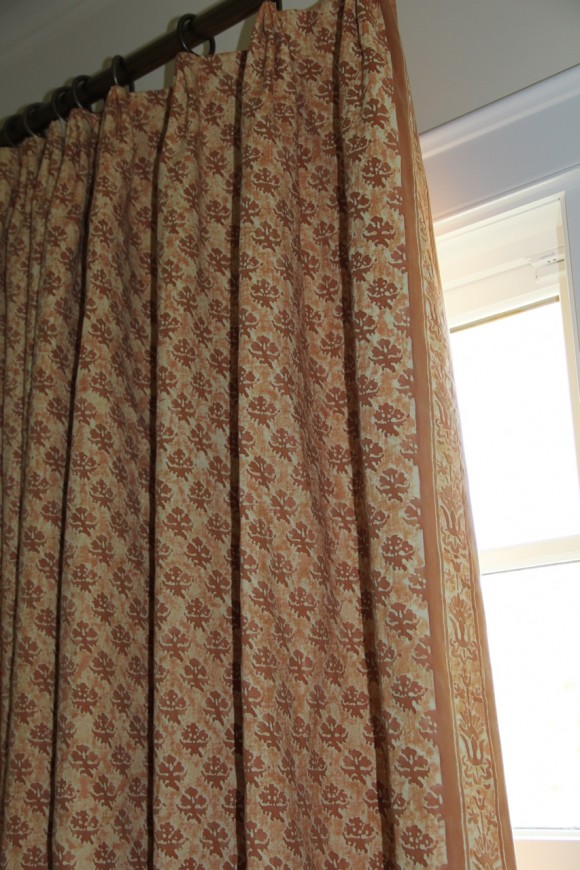
Here we took another Fortuny fabric – Persiano – and used its border for leading edges, but in a different, non-applied way. We just used the fabric’s selvage and turned it back to create the leading edges. This was made possible because the Persiano design has a double border on each selvage. As part of my dedication to spatial story-telling, I used the fabric here on the reverse, just to emphasize the narrative difference between the master and guest bedrooms.
Bedrooms are always the first thing I want to design, and always the last thing that I find myself tweaking. They are the rooms where clients start and end each day, so I give them a lot of extra attention. But let’s move on into the more social areas of the house.
The dining room presented another situation where I needed to dress the windows appropriately, but I definitely did not need or want to black out the light. We wanted to use a vintage linen with a subtle geometric print, but needed more yards than were on hand. Rose Tarlow‘s Vincenza came to the rescue.
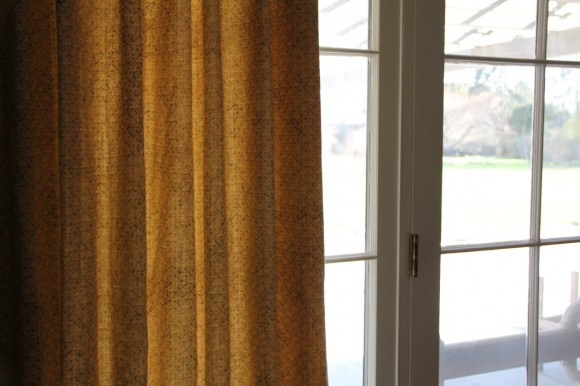
A new fabric that looks old, with the distress actually printed into the design. A coloring that works with the garden outside and will work with the furniture inside. Even though most of the furniture is still on a boat en route from Argentina, where we cleared out a ranch, I am confident that these curtains will do their functional and aesthetic job for the room. Even with no furniture yet, the well dressed window foreshadows the future story of this room, which will be all about intimate fireside dinners around an old Argentinian farm table in a room that opens up to the garden.
And now for a real in-progress look at the house. Nevermind that there aren’t any lampshades and that you can’t really make out any particulars of the room (that’s an intentional decision here). A lot of these particulars (like the coffee table, the lamps, the lack of a carpet) are changing anyway when the stuff from Argentina arrives.
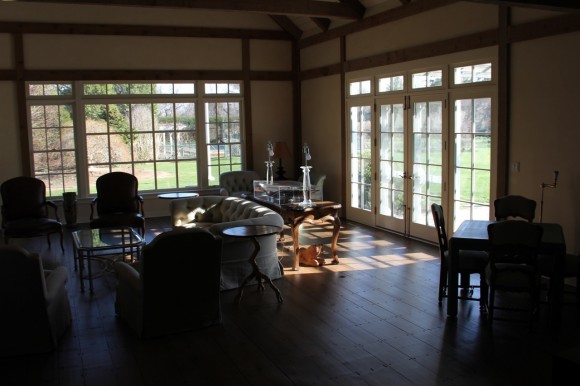
What captured my eye and imagination the first time I saw this room was the windows. Yes, we are changing them, and one of the ways that we are doing it is with beautiful custom embroidered linen sheers from Ranjit Ahuja, represented by ALT for Living in New York.
These clients had a house on the water for years in East Hampton. This house is not directly on the water, but it’s close, and I wanted to bring a beach element into their new space somehow. Ranjit Ahuja had an archived design of dune grass and reeds embroidered on linen. On the table in the photo below, the archived design is the one in green and red on a cream ground. Analisse, Ranjit, and I worked on a revision to this design, which is what I am reviewing in Ahuja’s Mumbai studio, where I had the good fortune to visit in person last month.
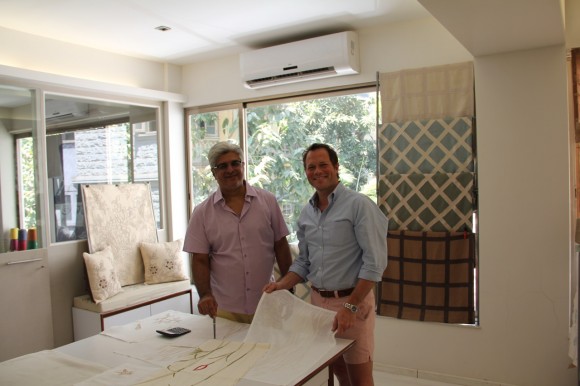
The living room curtains will be nine feet high. We are taking the design and embroidering it onto the lower four feet of the panels only, all in shades of white and cream (in that photo, I am holding the white strike-off in my hands). Roman shades elsewhere in the room will feature an all over close-up of the reed design. It’s a lot of design work to achieve something so simple, yes, but it’s also this kind of consideration and detailing that will give this room a truly bespoke vibe while telling the unique past and present stories of the people who live in it. It’s also most serendipitous that India is one of the clients’ favorite places in the world, and one where they spend a great deal of time.
The reeds are all about bringing the outside in, relating the interior to the garden and the landscape beyond, and that’s where the story continues. Jan Milne from Whitmore’s Lanscape Services is working wonders here with a garden that has a strong sense of genius loci. Having worked for several years as a garden designer before I turned to interior design full time, I have immense respect and appreciation for what’s happening in this garden.
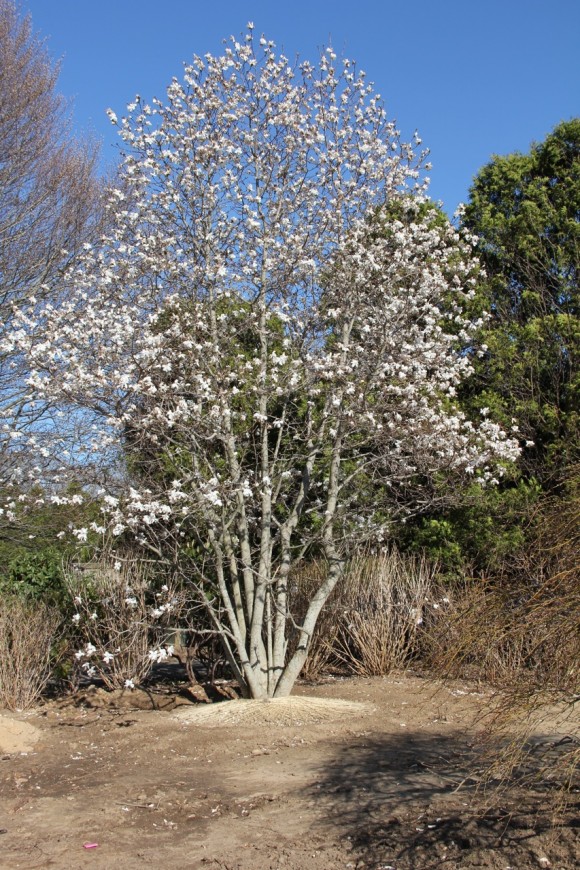
It is a real pleasure to be on the same creative team with someone who knows how to select, site, and plant a tree like this. And this is only one of many perfect garden moments that are happening all around this property.
As I reflect on this work in progress, and on the synergy between my interior designs and Jan Milne’s landscape designs, and between my clients’ stories and mine, I am reminded of one of my favorite quotations by design legend Van Day Truex, who said “In design, Mother Nature is our best teacher.”
Design, like nature, is a process that is endlessly changing. For those of us who love design and revere nature, we find our stories – and our clients’ stories – depend on a careful balance of both. I think that is what makes a work in progress (or is it a work in process?) something that warrants some attention every now and then.