
This year’s Design Leadership Summit was held in Copenhagen, where there is no shortage of design inspiration and aesthetic appreciation. We toured many famous and fabulous spots in the city, but I happened into one place where time seemed to stand still, where the sacred and the ordinary seemed to confuse and confound each other, and in which the design tenets of simplicity and eccentricity came together to create a truly soulful space. That place was the atelier, studio, shop, and home of Oliver Gustav on the Kongens Nytorv in Copenhagen.
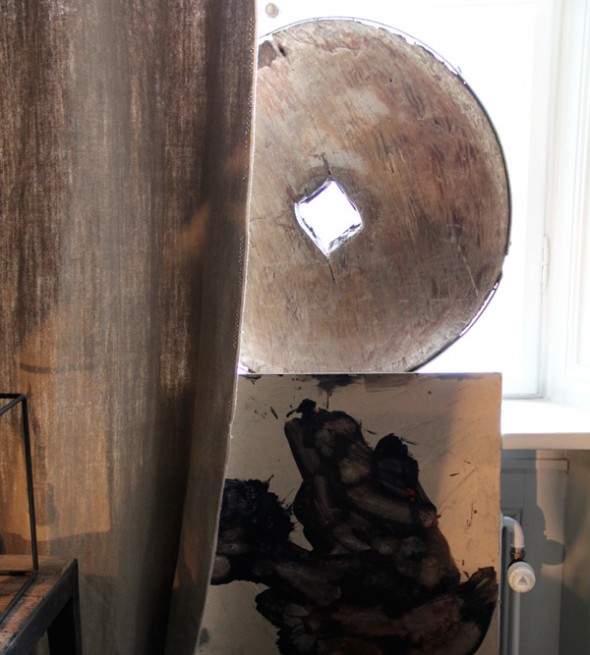
Right fabric, right place: a piece of unhemmed and unlined linen drapes the window facing onto the Kongens Nytorv.
I am always entranced by a space where ordinary objects – shirt collars, computer screens, cell phone chargers – are displayed alongside sacred ones: statues of deities, artwork, ceramics, ironwork. Gustav’s atelier, where he not only sells his antiques, but also lives and designs, is a stellar example of just such a space. A space where the ordinary and the sacred co-exist, and indeed, even become each other.
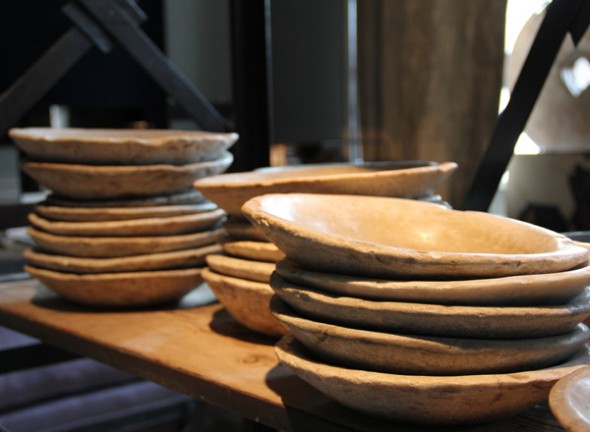
A carefully assembled collection of Indian ceramic bowls.
I am big believer in the beautiful display of everyday objects. Hence, I love this idea of putting everyday basic bowls and plates on open shelves (as above), or collars beneath a belljar, which is normally reserved for things like taxidermy animals or precious objects (as below).
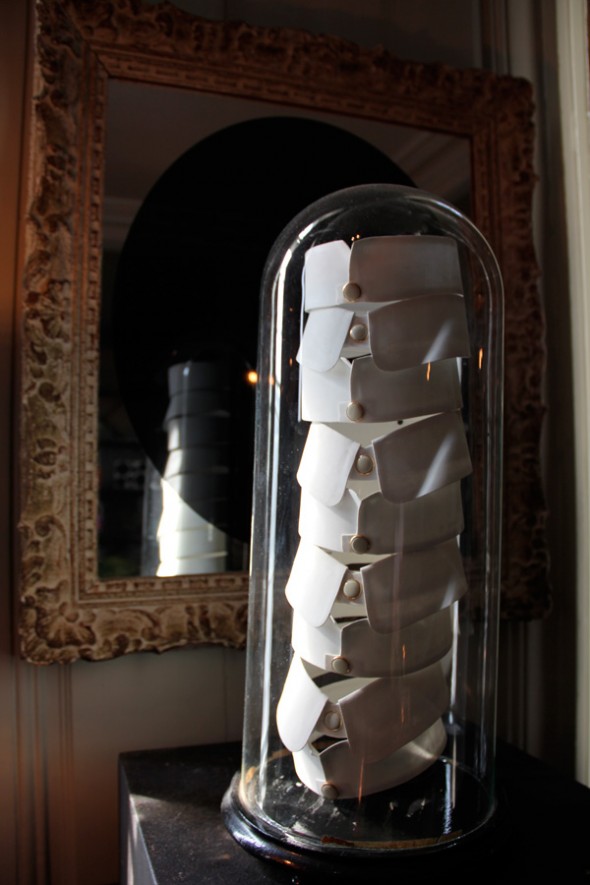
A tower of curated collars beneath a belljar.
By displaying something ordinary en masse and in the open, the ordinary object takes on an almost sacred quality. And so it should! Why not take pains to make sure that the things we use and touch on a daily basis are treated as beautiful, cherished possessions?
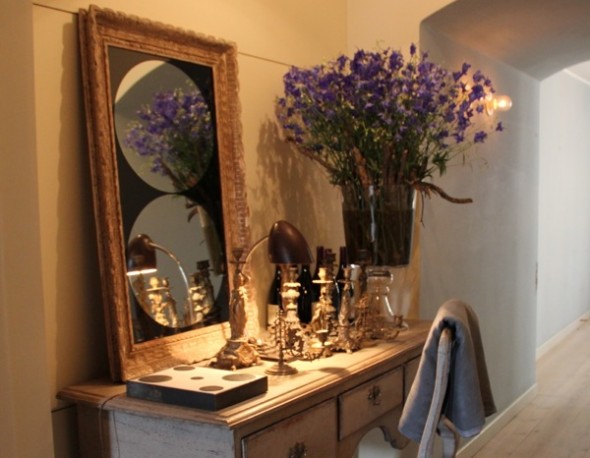
A collection of candlesticks, a painting laid on the desk, a double-circle mirror, and fresh flowers work to create a living still life in the corridor that serves as sort of foyer that links the studio with the kitchen and bathroom.
The entire trip was a delight, but this visit to Oliver Gustav’s spot on the main square was really an unexpected treat, and a place to which I hope to return very soon.