
One of the highlights of the last year, and a definite high-point in my career to date as an interior designer, is the creation of the collection of pillows that I created for and with Fortuny using their fabrics.
As my clients, friends, and any regular readers will know, I have a lifelong passion for Fortuny, and this small pillow collection was born as a result of a conversation that I had with the owners of the company, Maury and Mickey Riad, in Venice two years ago at the Design Leadership Summit (read a bit about it in a previous post that I wrote here).
After a little over a year of brainstorming, designing, and templating, we were lucky to see mention of this small collection of pillows alongside a nice mugshot of me and Mickey and Maury Riad in the Wall Street Journal, and even Architectural Digest Online did a nice blip on the collection entitled “Fortuny’s Heritage-Inspired Pillow Collection.” We also had an amazing launch party in January at the New York showroom with lots of fun clients, colleagues, and industry friends.
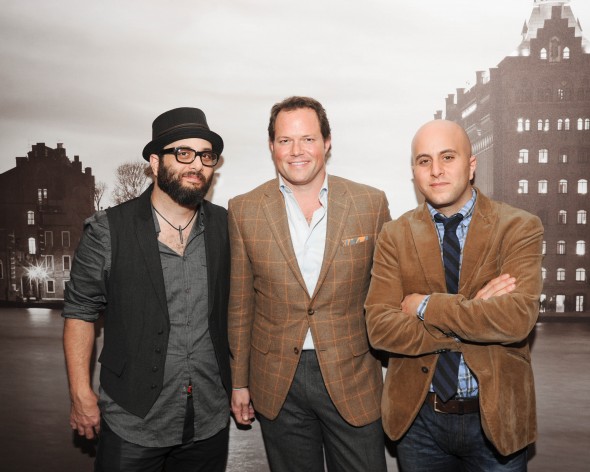
Mickey, me, and Maury as featured in the Wall Street Journal.
Mickey and Maury Riad featured some gorgeous pictures of the pillows on the Fortuny blog, and the Architectural Digest piece featured a couple as well, but I wanted to take this (long overdue) opportunity to show the collection in full, and discuss a little bit more about these pillows, how I designed them, and how we made them. After all, I am sucker for a design narrative.
Fascinated from a young age by the hand and the beauty of these fabrics, and as an adventurer at heart, I wanted to create a collection that referenced and honored not only the handmade quality of the fabrics, but also the adventurous spirit of the designs. Having discovered Fortuny at a young age, and having used it consistently for the fifteen years that I have been designing, I also wanted to do justice to the story that the fabric itself has to tell.
Thus: nature, travel and texture are the theoretical threads that hold the collection together. I focused first and foremost on designs which refer to some faraway place and invoke my passions for travel and ethnic textile design: the exotic patterns of the Polynesian Tapa with Stripe (still my favorite of all), the African Ashanti, the Peruvian Cuzco, the Moorish Moresco, the Moroccan Rabat, the Persian Piumettes, the South American Mayan. I then layered in some of my favorite floral motifs: the structured and organized Impero and Melagrana patterns, and the more whimsical Cimarosa, not to mention the classical Petite Trianon-inspired Malmaison.
The picture below shows me going through several different patterns to select the ones that would make it into the collection.
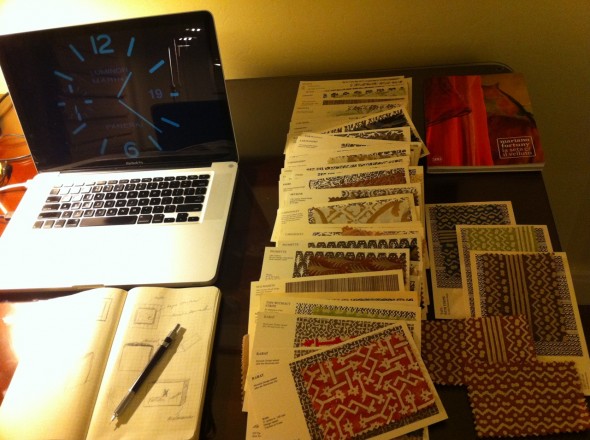
Playing with patterns, early designs for the collection.
After pattern and texture came the color palette. I chose the palette based on landscapes that are sacred to me, and wanted to reference the tensions within and between those landscapes: turquoise waters and glistening white snow, pale morning skies and stormy afternoon clouds, fresh green grass and rusty autumn leaves, glowing terracotta cliffs and wet inky riverbeds.
So, with this inspiration palette composed of equal parts familiar and exotic, I set out to create a collection that deconstructed and reconstructed some of the patterns as a means to illustrate not only the multiple possibilities within the designs, but also to reveal the fabric’s inherent modern qualities. The collection is thus not only about putting some of the patterns together in possibly unexpected and heretofore unseen ways, but also about taking them apart and putting them back together in ways that encourage a rethinking of them.
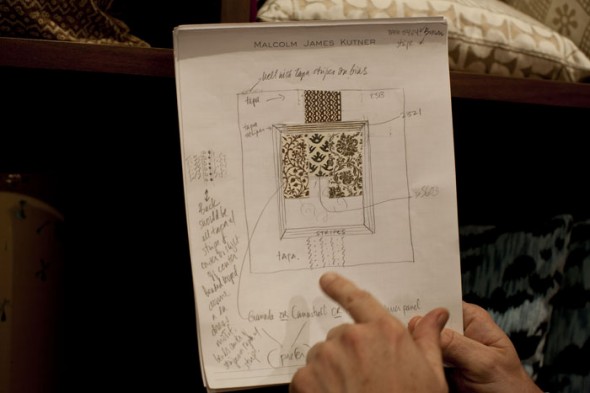
Sketch of one of the designs, what will eventually become the Tapa Canastrelli pillow.
The above sketch became the Tapa Canastrelli pillow seen below. This is a great example of how the pillows were sewn with unwavering attention to detail. Note especially the way that the Tapa’s stripe is mitered, not only as a frame around the Canastrelli, but also as a small flange that edges the entire pillow. The reverse of the pillow (show on the pillow behind the first one) features the Tapa with Stripe pattern untouched.
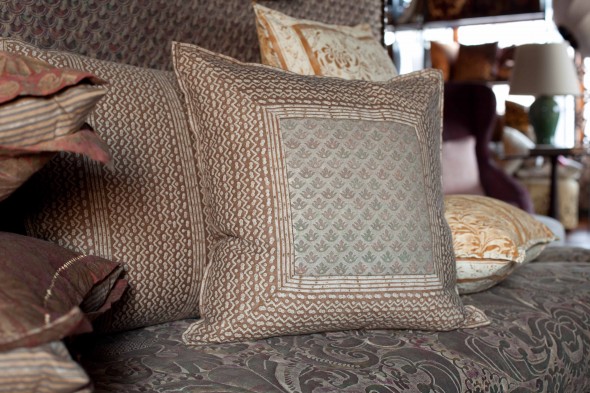
The Tapa Canastrelli pillow
When asked recently about how the pillows were made, I replied that they were made with “precisedressmaker details,” and by that I mean primarily two things. I insisted on a very precise way of sewing the pillows – the invisible zippers, the mitered corners, the immaculate seams that happen where I removed one part of the pattern and then sewed it back together. A tireless and bordering on obsessive attention to detail.
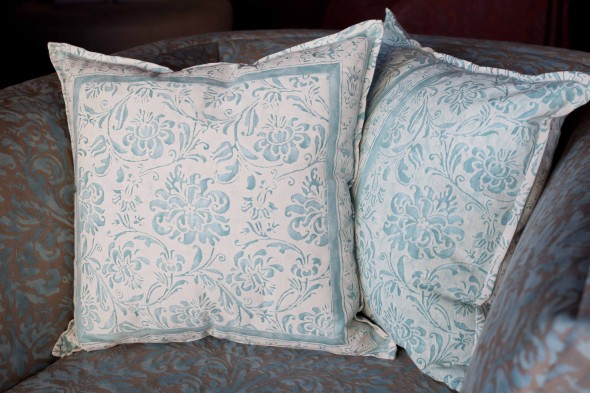
Cimarosa pillow
I also consulted some of Mariano Fortuny’s original dresses, and reference some of the details that he used on his dresses. For instance, the back of the Cimarosa pillow (above in blue and below in pink) features the border of the fabric running straight down the middle, much like some of Fortuny’s dresses featured a dramatic contrasting button closure/placket running right down the middle of the back. I also played with the face and reverse of the fabrics, again evident here. The front of the pillow is the face, while the back features the fabric on reverse. Fortuny is famous for being equally beautiful on the reverse as it is on the face, and so I wanted to offer some reference to that as well.
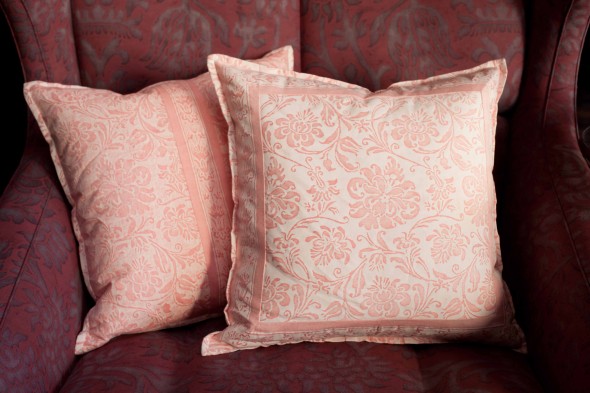
Cimarosa in pink
Similarly, one of my favorite designs – the Moresco – was taken apart to reveal a pattern within a pattern. Below, one can see how the pillow on the left features the pattern as it is printed, with a predominant cross or “x” motif. On the right, note how I have cut part of the design out, then stitched it back together to reveal a previously unseen octagon within the design. The boxed border is taken from the often ignored border of the fabric.
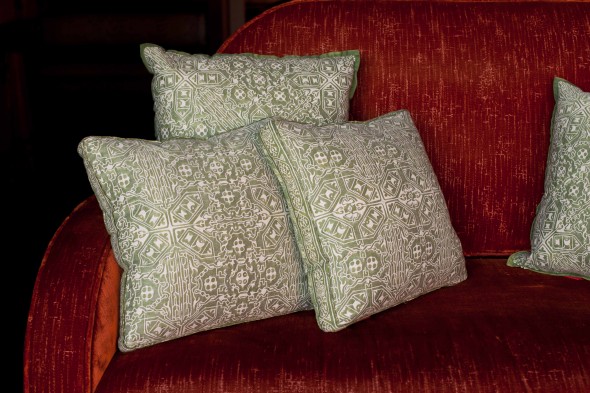
Moresco pillow
Also, in the Moresco series, the use of the selvedge is apparent in the flange and the boxed edge (note the detail shot below). One of the requirements I set for the collection was that it would use only Fortuny fabrics, and no other fabrics, trims, or embellishments. I felt that between the fabrics two sides, solid selvedges, and gorgeous borders, I felt that the fabrics themselves offered a plentiful palette with which to work.
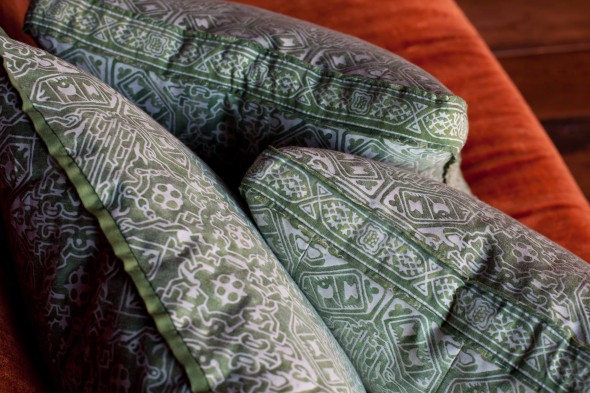
Flange and boxed edge details of Moresco
The Ashanti pattern is another one of my favorites, taken from ancient tribal African designs. For my collection, I chose to work with the gold and white colourway. Every single pattern within this design is unique in size, shape, and design.
Thus, we had to use two full repeats to achieve a set of pillows that would allow accommodate the border design in the very precise way that I wanted. No two pillows are the exact same size, but I think that this collection en masse could fill a sofa in the most wonderful way.
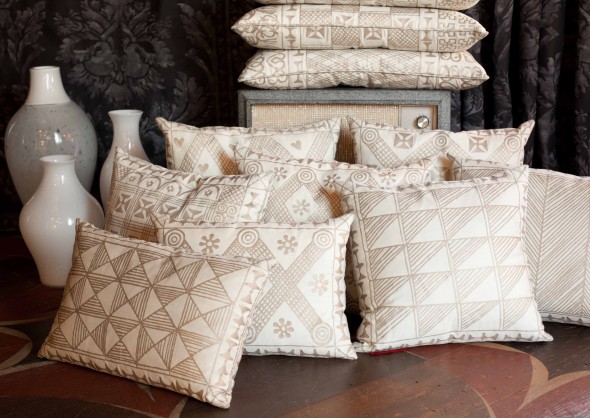
Some of the Ashanti pillows
One of my preferred designs, this Ashanti was also the design I chose for the Fortuny Giudecca lanterns when designing the chandelier for a client in Manhattan alongside the Alpha Workshops, and which I discuss in another post here.
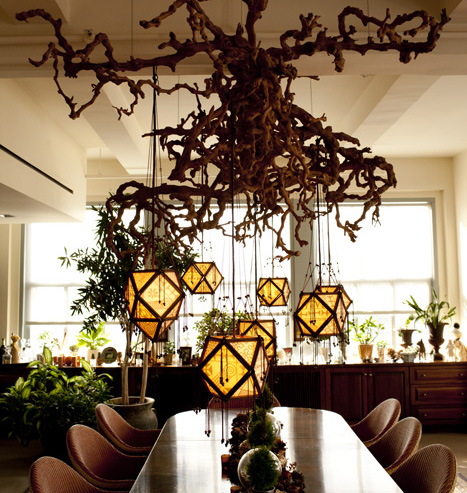
Chandelier using Ashanti, photo by George Lange
Perhaps the most complicated pillow to construct is the one that the Riad Brothers have dubbed the “Plate Pillow.” I refer to it as the “Sandwich pillow.” Plate or sandwich, or maybe it’s Sandwich on a Plate, the reasons are obvious. The one below is featured in the Piumette design in the most gorgeous shade of turquoise that I have maybe ever seen in a textile. It’s featured here with a deconstructed-then-reconstructed lumbar pillow of the Mayan pattern. Note on the latter the way that we removed the internal zigzag and reapplied it as the flanged border.
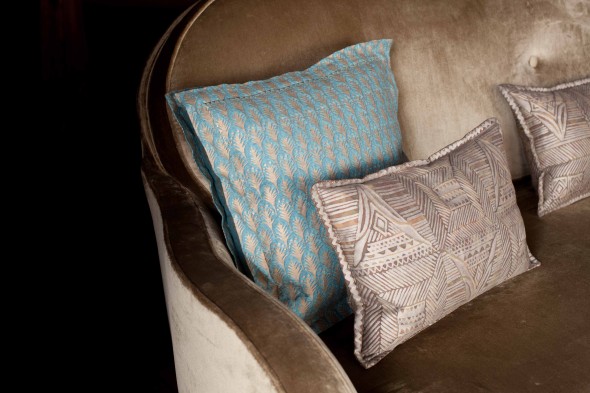
Piumette Plate Pillow, with Mayan Patchwork Pillow in front
And here is another version of the Plate or Sandwich Pillow, this time in the Impero with the Malmaison. Topstitched details for these pillows was necessary, and so we did it in metallic threads in a strong geometric stitch.
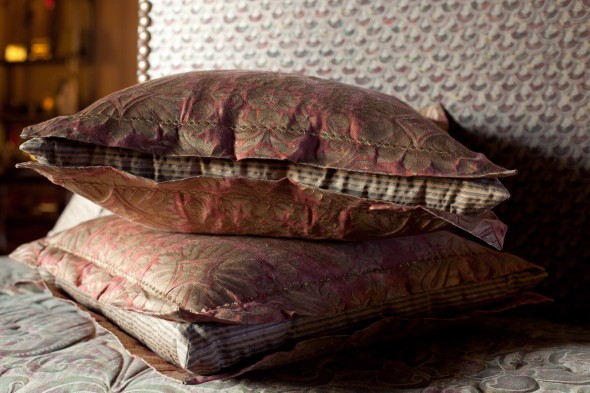
Impero Meets Malmaison Sandwich
And finally, I especially like the way Mickey Riad photographed these pillows below in the context of a keyboard. There is, after all something musical about the fabric, the designs, and the company.
This also showcases the pillows against the most the Glicine fume nero texture, one of the recent and amazing Colourismo Collection fabrics that the company launched earlier this year.
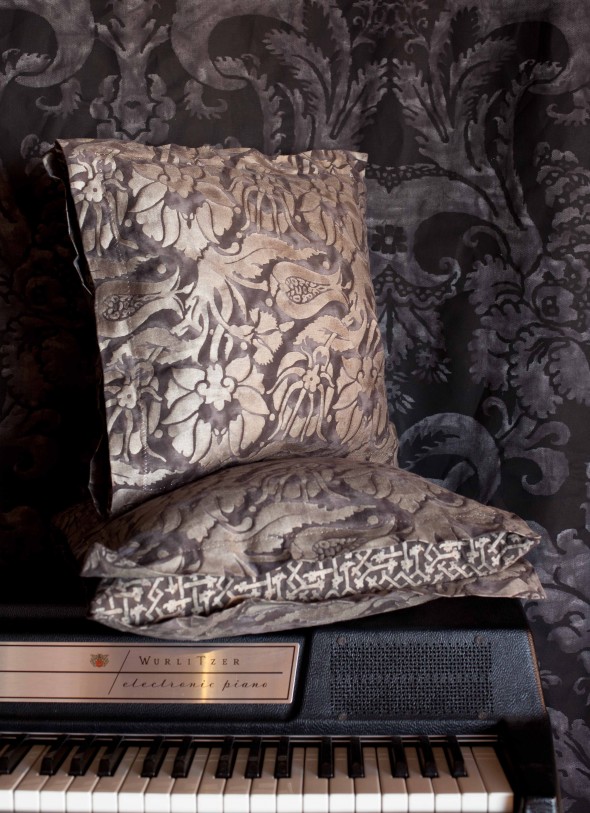
"Plate Pillow" featuring Melagrana and Rabat
Mickey Riad actually photographed all of these photos of the actual pillows, and he and his brother were the masterminds behind the new Colourismo Collection. Be sure to read his post about the Colourismo launch (and other things) in Paris this past January here.
And be sure to check out the Fortuny website, or even better, if you are in New York, pop into the Fortuny showroom at 979 Third Avenue to see the pillows and other examples of fine design in person. There, after all, no on-sscreen substitute for the real deal.